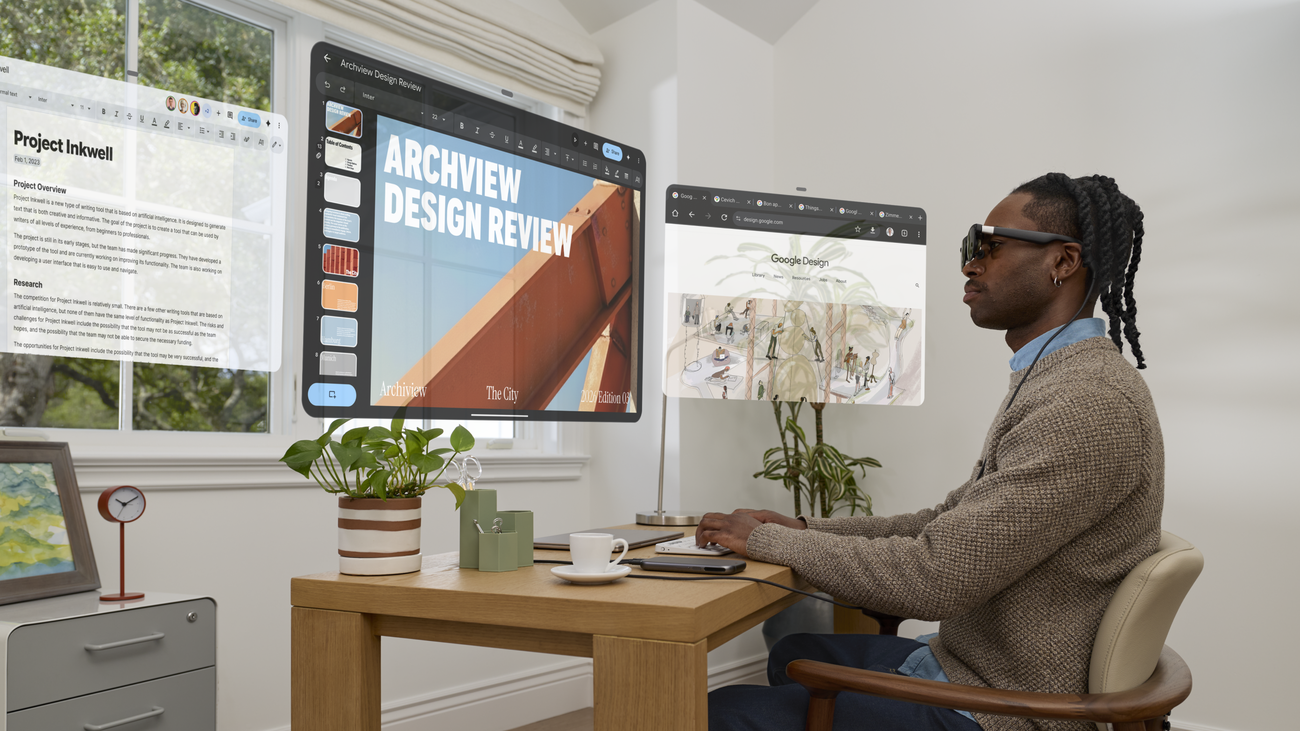
Google and Xreal have opened orders for the XREAL AURA glasses, the first wired headset to ship on Android XR. The pair went on sale on 28 October 2026 in the United States, Canada and South Korea. Japan follows on 2 November. Launch pricing starts at $1,099 through the end of the year. Shipments are due from mid-November. That timing puts a real product on doorsteps months before Meta’s VR Glasses, still aimed at spring 2027.
The move matters beyond a single SKU. Buyers can now get glasses-shaped Android XR with Gemini built in, a tethered compute puck, and a clear price cut against earlier pre-order figures. For anyone watching the glasses race, the XREAL AURA glasses set a new bar for what “shipping soon” actually means.
What the XREAL AURA glasses are
According to Google’s official Android XR blog, AURA is a pair of transparent XR glasses. They project apps into your field of view while keeping the real world visible. The glasses themselves weigh under 95 grams. Processing and battery sit in a portable compute puck on a cable. So the face load stays light while the puck carries Qualcomm’s new Snapdragon Reality Elite platform.
Google puts the field of view at 70 degrees. That is wide for optical see-through glasses. It is still far narrower than a closed Quest-style headset. Displays are Micro-OLED panels. Reporting from TechCrunch adds Sony panels at 1200p and 120 Hz, plus Bose audio tech for media playback. Those panel details come from secondary coverage rather than Google’s blog. Treat them as reported specs until Xreal’s full sheet is locked in.
The puck doubles as a trackpad. You can also pair a Bluetooth keyboard and mouse. That gives a desktop-style layout of windows around you. Wired Mirroring lets a USB-C laptop feed its screen into AURA as a resizable window beside Android XR apps. No extra software install is needed on the laptop. That design targets hotel desks, aeroplane trays and sofas as much as desks at home.
Price, configs and where you can buy
The Verge reports that the 12GB RAM and 256GB storage model now costs $1,099 through year-end. That is down from a $1,279 pre-order price. The 16GB and 512GB model is $1,299 under the same launch offer, down from $1,499. Xreal says buyers who pre-ordered at the higher price will get an automatic refund of the difference. Orders are live at xreal.com and, in the US, at Best Buy.
Availability for the XREAL AURA glasses is still narrow. Google lists the United States, Canada and Korea today, with Japan from 2 November. Broader markets follow next year. Buyers must be 18 or older and need a compatible account. Enterprise deployment is flagged separately through Android Enterprise channels. So the XREAL AURA glasses are real to order. They are not a worldwide walk-in product yet.
Software: Gemini, Play and made-for-XR apps
Android XR is the main software story. Google says AURA brings millions of Google Play apps plus more than 150 experiences made for XR. Gemini can see across your apps and surroundings. It can answer questions about what is on screen. It can also highlight things in the room when you share your view. Google Photos is getting a spatial gallery that wraps a library around you and opens memories in 3D.
Launch content called out by Google and Xreal includes immersive films such as “Nevatars”, co-directed by Andy Serkis. “Galapagos: the Last Eden”, narrated by Margot Robbie, is also listed. So is the San Francisco Ballet’s “Nutcracker”. Games named at launch include titles from Owlchemy Labs and Resolution Games. Fallout Factions and Project Hail Mary: Journey Among the Stars are listed too. TechCrunch also notes the NBA app for Android XR and a NASCAR XR app among the early line-up.
Lens dimming can fade the world for private viewing. The lenses clear again when someone enters view. Window follow mode keeps an app centred, or tucks it to a mini view while you walk. Spatial view can turn many videos, photos and games into 3D with a tap. None of that replaces a deep software review. Still, it shows Google pushing everyday Android habits into glasses rather than asking buyers to learn a closed store from scratch.
How they compare with Meta VR Glasses
Meta announced its ultralight Meta VR Glasses at Connect in September 2026. The price is $1,299.99 for a spring 2027 start. Those glasses also use a face-worn display with a tethered compute puck and Snapdragon Reality Elite. Meta pitches a closed VR canvas with IMAX Enhanced video and a Quest app carry-over story. AURA, by contrast, keeps transparent lenses and leans on Google’s existing Play and Gemini stack.
Sticker price is lower: the launch offer for the XREAL AURA glasses undercuts Meta’s announced figure by about $200 on the base config. Calendar favours AURA, which ships first. Weight is similar, with both near 95–100 grams on the face. Field of view for AURA is about 70 degrees see-through. Meta’s VR Glasses use a different optical approach with a much narrower FOV than Quest 3, as covered in developer notes around Connect.
The two products also serve different privacy and social postures. Transparent glasses keep eye contact and ambient awareness. Fully immersive VR glasses trade that for cinema-style isolation. Buyers who want a private cinema may lean Meta’s way when it arrives. Buyers who want maps, docs and Gemini while still seeing the room may lean toward the XREAL AURA glasses now. Neither device is a like-for-like Quest 3 replacement for controller-heavy gaming.
Meta’s Quest pause makes the launch sharper
Days before AURA’s order window opened, Meta’s third-quarter earnings call reinforced a slower Quest cadence. Mark Zuckerberg said Meta will “only ship new devices when we have major breakthroughs.” He pointed to the Meta VR Glasses as the example. Coverage from GamesRadar+ and VR.org notes that Quest 3 and Quest 3S remain the near-term build targets. No end date was given for that stance.
Zuckerberg also said Reality Labs will pace VR investment more tightly while focusing on “personal superintelligence,” with Muse coming to Meta Glasses. He guided Reality Labs operating loss toward about $15 billion next year and then toward profitability. For the market, that means fewer yearly Quest resets. It also puts more weight on glasses-shaped form factors. AURA’s arrival into that gap is not an accident of timing.
Caveats buyers should weigh
First, the cable and puck are part of the product, not an accessory. You trade face comfort for something in a pocket or bag. Second, a 70-degree see-through FOV still frames content in a window rather than filling your vision. Third, launch countries are few, and shipping starts mid-November rather than same-week. Fourth, long battery life, outdoor brightness and all-day comfort need independent reviews. Those reviews do not exist yet on day one of orders.
There is also a software maturity question. “Over 150 made-for-XR experiences” is a start, not a saturated store. Gemini’s room-aware help will vary with lighting, network and account setup. Wired Mirroring needs a USB-C path that supports video out. None of these issues kill the product story. They should, however, temper day-one expectations for the XREAL AURA glasses.
What this means for the wider XR market
Google is following its phone playbook: ship the platform through partners. Samsung remains in the Android XR story as well, while Xreal brings glasses optics experience. Meta still owns much of the installed Quest base and the spring 2027 glasses slot. Apple’s Vision Pro stays a premium spatial computer on visionOS. Its recent updates have been smaller point releases rather than a mass glasses push in this same week.
Developers gain another profile to test: transparent canvases, Gemini hooks, puck input, and laptop mirroring. Retailers see Best Buy’s US listing as a more mainstream channel than Founder’s Edition waitlists. Investors watching Reality Labs losses will note a competing glasses SKU at a lower launch price, which adds pressure on Meta’s $1,299.99 ask. That pressure arrives before Meta’s device even ships.
In short, the XREAL AURA glasses turn Android XR from a demo-stage talking point into something you can order today. Alone, that shifts the conversation from keynotes to fulfilment dates. Return rates and habit formation for Gemini-on-glasses will decide whether this is a durable category or a novelty.
FAQ
When do the XREAL AURA glasses ship?
Orders opened on 28 October 2026 in the US, Canada and Korea. Google says shipments begin in mid-November. Japan opens on 2 November, with wider availability expected next year.
How much do they cost?
Launch pricing starts at $1,099 for the 12GB / 256GB model through the end of 2026. The 16GB / 512GB model is $1,299 under the same offer. Earlier pre-order prices were higher. Xreal says it will refund the difference automatically.
Are they VR or AR?
They are optical see-through XR glasses. You see the real world through transparent lenses while apps and media sit in your view. That differs from closed VR headsets such as Quest 3 or Meta’s upcoming VR Glasses.
Do they replace a Meta Quest?
Not for most controller-first VR games. AURA targets work, media and Android XR apps with Gemini. Meta still points Quest developers at Quest 3 and 3S until a later breakthrough device. Its own glasses arrive in spring 2027.
Where can I read the primary sources?
Start with Google’s AURA launch post. Then cross-check pricing and configs with The Verge. Hardware notes on TechCrunch are useful too. For Meta’s hardware stance, see the Q3 remarks summarised by GamesRadar+ and VR.org.